Housing is a Treaty Right

Good morning members of Edmonton City Council. I am Miranda Jimmy and a proud member of Thunderchild First Nation. I have made my home in Edmonton for more than half my life and have lived for more than 40 years in my traditional homeland of Treaty No. 6.

I am here today out of my responsibility to the ancestors who came before me, the unborn yet to come and my relations who aren’t given a voice in this chamber. I am here to share my own personal perspectives and am not representing anyone else.

I am a resident who wants to live in a city that supports neighbourhoods for people from all walks of life. I am here because I believe that everybody deserves safe, stable, and attainable housing. I believe that every person in this city deserves to be treated with dignity and respect. I want our city to not just build neighbourhoods but support the growth of communities – spaces where people are uplifted by one another and are stronger because of the bonds they share.

Most importantly, I want a municipal government that is brave enough to make decisions in the best interests of all peoples and the wellbeing of all our relatives. I want to see support for the good of our communities, and consideration of everyone’s needs rather than the ones privileged enough to directly voice their concerns before you today.

The community of Wedgewood Heights provides many unique opportunities for the inclusion of affordable housing. The site is appealing for so many reasons and I am sure the residents who already make their home there would agree. The location has easy access to Edmonton Transit and quick access to Henday Drive for mobility around the city. The site is a short walk away from a grocery store, coffee shop, restaurants, and other retail amenities. There is access to daycare facilities and schools. The community is surrounded by natural greenspace, with trails through Wedgewood Ravine and connected to the North Saskatchewan River Valley. Building family-oriented affordable housing in such a prime location will be setting these children and families up for success in a stable, well connected community.

As much as I am here to speak about my own views on the city I want to call home, I am also here to focus on the positive impact this development could have for those families. I spent most of my young life without a stable home, moving every few years as rents increased and income changed in my single parent household. I know what cramped quarters feel like and how your sense of stability is non-existent when you live out of boxes, never feeling settled. I also know that those feelings can be reversed when you have a bedroom to call your own, a home where your neighbours are your community, and you have what you need and can provide others with better than you had growing up.

Members of City Council, I want to to think about the kids who will live in these townhomes. The opportunity that stable housing can provide in their most formative years. Think about all of the things you are grateful to have in your neighbourhood and the chance to offer that to others who are struggling in our city. Think about the next generation of civic leaders who can be uplifted from poverty and instability through good public policy and decision making.

You have an immediate and tangible opportunity before you today to use your decision making power to directly respond to our city’s housing crisis. You can demonstrate your commitment in the Letter of Intent with Treaty 8 First Nations of Alberta and your ongoing commitment to more Indigenous-led affordable housing options in Edmonton. Most importantly, you can allow for homes for 60 families and upwards of 300 children, adults and Elders. Your decision today will demonstrate to me and other residents your willingness to stand behind your commitments, respond to the needs of our growing city, and uplift the most vulnerable who rarely get the opportunity to stand before you but are impacted by every decision you make.

Before I close, I want to remind you – the elected members of City Council, members of City Administration, and all the members of the public here today – you all have a responsibility to the spirit and intent of the Treaty Relationship. Whether you are a settler whose family has lived here for many generations or a newer arrival from somewhere else, each of us holds a moral, ethical, and legal obligation to this agreement. We are all Treaty People. Treaties paved the way for Edmonton, Alberta, and Canada to exist but many of the promises have not been upheld. Through approval of this Land sale today, in a small but important way you are upholding your Treaty obligations. You are clearly saying First Nations have a right to this Land, we have a right to housing, and we have a right to belong in our homelands.

All my relations.


The preceding speech was shared at a City of Edmonton City Council Meeting on February 18, 2026 in support of Financial and Corporate Services Report FCS03329: Wedgewood Heights Below Market Value Sale, Lease or Other Disposal Approval. A video recording of the proceedings can be found online here.

Respecting Data Sovereignty Starts With the Stories We Tell About the Past

Provincial Archives of Alberta PR1991.0443/21 (redacted)

Last year I was invited to the Owning History: Indigenous Histories and Records Access Conference organized by Dr. Mary Jane McCallum at the University of Winnipeg to talk about my experiences working with residential school survivors and their loved ones to access archives. As one of the only non-academics in the room, I titled my presentation, “Novice Navigator: Tales of My Time Breaking Down Barriers in Public Archives,” to reflect how I situated myself as a curious disrupter within institutions of colonial memory. Having spent more than a decade in public archives looking for the truth about my family’s history, and supporting other Indigenous community members in their searches, it has become very clear to me that public archives are withholding information from those who need it the most in order to preserve a heroic vision of Canadian history premised upon deeply racist beliefs about Indigenous Peoples. An obvious example of this is how many First Nations, Inuit, and Métis people remain unnamed in photographs and historical narratives while lengthy lineages exist for their white counterparts.

My volunteer work has primarily been centered on publicly held records related to residential schools and Indian hospitals in government and private records, working well outside the confines of academia and blurring the lines between living memory and documented proof. The more I looked, the more obvious the intention to hide the truth was, both in the records that existed and in the ignorance of the people who manage those records to do so in a responsible way that presents a balanced understanding of the past. I feel the need to learn what I can about archival practices and processes to help the people who needed the information – survivors and their loved ones – and figure out how to infiltrate the system that was keeping the information from those who needed it most.

As I reflect further on archives and western approaches to historical research, it is clear that institutions of colonial memory are consistently used against Indigenous Peoples as a weapon. This unjust weaponization comes from what is considered accurate information, who has access to its collection, management, and manipulation, and who has the right to challenge its validity. When it comes to representation of Indigenous Peoples in the archives, the responsibility of ‘the what’ and ‘the who’ has often rested solely within documentation obtained from colonial governments and their agents.

The following questions are essential for public archives and the historical discipline to consider and ask themselves:

  • Who owns the information in the records?
  • Who has the right to copy or grant access to this information?
  • Who should be recognized as the rightful keeper of this knowledge?
  • Who is responsible to collect, preserve, and care for this knowledge?
  • Who has the right to answer any of these questions?
  • What is the story being told in the records that are kept?
  • Who owns the story/stories and information contained in them?
  • What perspectives are being intentionally or unknowingly privileged and perpetuated?
  • Who can challenge the documented record?
  • What responsibility do researchers and historians have in shifting the narrative?
  • What responsibility do archivists, archives, and other memory institutions have?

In 1998, the First Nations Principles of OCAP® were established recognizing the importance of Indigenous data sovereignty through ownership, control, access, and possession of information. A decade later the Assembly of First Nations created the First Nations Information Governance Centre to “promote, protect and advance the First Nations Ownership, Control, Access and Possession (OCAP®) principles, the inherent right to self-determination and jurisdiction in research and information management.” At the same time, movements for Indigenous data sovereignty were emerging internationally leading to the creation of the Global Indigenous Data Alliance and the CARE Principles for Indigenous data governance and the FAIR Principles for scientific data management.

But archives containing data and information and academic research on Indigenous Peoples existed long before OCAP® or CARE so that means there is a lot of catching up to do. Archives, and the researchers, historians, and archivists that are trained to create, navigate, and perpetuate them, need to question their own commitments to reconciliation through righting these wrongs and beginning to address Indigenous data sovereignty through meaningful, tangible change.

In the “What We Have Learned” volume of the Truth and Reconciliation Commission of Canada’s Final Report, the Principles of Reconciliation state that “the United Nations Declaration on the Rights of Indigenous Peoples (UNDRIP) is the framework for reconciliation at all levels and across all sectors of Canadian society.” Although UNDRIP doesn’t speak directly to information and data, its 46 Principles are based on free, prior informed consent. More specifically, articles 18 and 19 respectively speak about the role of Indigenous Peoples in decisions that impact them:

  • Indigenous Peoples have the right to participate in decision-making in matters which would affect their rights, through representatives chosen by themselves in accordance with their own procedures, as well as to maintain and develop their own Indigenous decision-making institutions.
  • States shall consult and cooperate in good faith with the Indigenous Peoples concerned through their own representative institutions in order to obtain their free, prior and informed consent before adopting and implementing legislative or administrative measures that may affect them.

In the absence of a role for Indigenous Peoples in governing public archives that contain our information or dictating the approaches on how this and other information is gathered by historians and researchers, Nations have been creating their own memory institutions for centuries that protect, preserve, and pass down information through our own laws and governance structures. These approaches to sovereign data management have allowed for languages, knowledge, and traditions to continue to exist despite attempts by colonizers to capture them, erase them, or steal them for their own use. In more recent years, Indigenous-led memory institutions have been created to meld old ways of holding knowledge with modern approaches to data collection and storage without the need to include or involve outsiders. This is part of taking back control of information for the benefit of the Nation and community, rather than academia, and ensuring it continues to serve revitalization and resurgence. The Haida Repatriation Committee has been actively working since 1995 to repatriate ancestors and historical objects from museums across Turtle Island and beyond to Saahlinda Naay Saving Things House, also known as the Haida Gwaii Museum. And after decades of ceremony, story collection, and fundraising, Woodland Cultural Centre reclaimed the former Mohawk Institute Residential School as an Interpretive Historic Site and Educational Resource to begin to tell this history guided by the Hodinohsho:ni Great Laws of Peace.

If you’ve managed to make it this far into my rant, I hope you are curious enough to understand your responsibility in fixing the mistakes of the past and forging a different, more equitable future for archives and transforming approaches for historical research practices. This rebalancing starts with the belief that Indigenous Peoples, like all peoples, deserve to make informed decisions about what information about them is collected, documented, stored, and accessed. If you share this belief, then it’s a matter of transferring that to the systems that you know and navigate.

  • How can the Principles of OCAP® be used as the basis to completely revolutionize public archives and government held data?
  • How will you change your habits and ensure free, prior informed consent in the work you produce?
  • How will you advocate for more equitable and just practices in the institutions and networks you are connected to ensure respect for Indigenous data sovereignty?

The preceding  blog was commissioned for Active History and appears as a part of the series “Telling Truths about the Settler Colonial Project.

Engagement is Not Consent

I am Miranda Jimmy and am a member of Thunderchild First Nation. I have lived in Edmonton for more than half my life. I am here to speak with you as a First Nations resident of Edmonton who accesses, appreciates, and advocates for the river valley on a daily basis.

More importantly, I am here to speak with you today because my ancestors have been here since time immemorial. My relatives have been accessing the river, surrounding valley, and the connected ravines and watershed since long before this place was referred to as Edmonton, before Alberta or the nation state known as Canada existed. My ancestors visited here, held ceremonies, gathered medicines, and most importantly, stewarded the Land and water in a way that allowed for us all to benefit today. They knew, just as we know, that the river is what sustains all life for the two-legged, the four-legged, the winged, the finned, the rooted, and the flowing relatives that surround us and provide for our well-being.

I am also here on behalf of future generations. I am thinking about those who will come after us and the legacy of stewardship we are leaving for them. I am worried about how our decisions today will impact their ability to access and appreciate all the gifts the river valley has to offer.

At the start of the week when we collectively recognize the 149th anniversary of Treaty No. 6, I carry the weight of the past, present, and future as I speak before you today.

Treaty No. 6 flag raising at Edmonton City Hall for Treaty No. 6 Recognition Day on August 23, 2024
(Photo courtesy of the Confederacy of Treaty Six First Nations)

In 2021, the City of Edmonton launched the Indigenous Framework to all City Staff. At the same time, City staff were already working on engagement for the River Valley Planning Modernization Project, the result of that work is before you today. I had hoped that because these two important projects had launched around the same time, Indigenous involvement in river valley planning would be different than it had been in the past. That is not the case.

Commitment one of the City’s Indigenous Framework is: “Support the journey of Reconciliation by applying the TRC’s 94 Calls to Action, the 231 Calls for Justice from the Missing and Murdered Indigenous Women and Girls Inquiry, and the 46 articles of the United Nations Declaration on the Rights of Indigenous Peoples as a foundation for the Indigenous Framework.”

The City of Edmonton recently released its annual update on the Indigenous Framework publicly. What this report and the City has failed to do is be accountable to this first commitment in practical ways, like demonstrating changes to decision making processes that implement the UN Declaration and the TRC’s Principles of Reconciliation.

The basis for the UN Declaration is free, prior, informed consent. In simple terms this means that Indigenous Peoples as Rights Holders to the Land in their territory must be involved in and consent to every decision made that impacts their peoples and Lands. Every parcel of Land you call Edmonton is the traditional and Treaty Land of First Nations Peoples, most of which the City has a formal partnership agreement with. In those agreements, the significance of the Land is acknowledged, specifically the importance of and relationship to the river and its surrounding valley.

The City of Edmonton’s Indigenous Framework is not a document, it is the work of reconciliation that is given life each time Council and Administration chose to ensure it has a place in their actions and decisions. City Council, please ask Administration and yourselves today – has the City of Edmonton reached the threshold of free, prior, informed consent with the more than two dozen Indigenous Rights Holders whose traditional territory will be impacted by this plan. I am challenging you as the City of Edmonton’s decision makers and as Treaty People to be accountable to your own Indigenous Framework, the MOUs you have in place with Indigenous Nations, and to Treaty No. 6.

In my opinion, the ARP and bylaws before you today do not meet the threshold of free, prior, and informed consent – the basis of the United Nations Declaration on the Rights of Indigenous Peoples and the TRC’s Principles of Reconciliation. The plan also does not include a requirement for Indigenous consent on future decisions made under these updated rules.

Indigenous engagement does not equal consultation. And Rights Holder consultation does not equal consent. The invitation to engage is not free, prior, informed consent.

I am not asking you to follow my advice. I am asking for follow through on the promises you have already made and are accountable to in the City of Edmonton’s Indigenous Framework.

You can demonstrate your commitment to the Framework today by requiring the articles of UNDRIP through free, prior, informed consent by Indigenous Peoples be the foundation of planning for the river valley now and into the future. You acknowledge Indigenous Peoples and Land at the start of every meeting. It’s time you begin to meaningfully honour the spirit and intent of Treaty No. 6 in your decision making.

Thank you on behalf of all my relations.


The preceding speech was shared at a City of Edmonton Public Hearing on August 18, 2025 in opposition of Bylaw 20996 – To adopt a new North Saskatchewan River Valley Area Redevelopment Plan . A video recording of the proceedings can be found online here.

I am a Treaty Indian

I am a Treaty Indian. I am a direct descendant of First Nations People that signed a Treaty with the Crown and whose name appears on the Indian Register maintained by the Government of Canada.

I am a nêhiyaw-iskwêw (Cree Woman) and proud member of Thunderchild First Nation, which signed the adhesion to Treaty No. Six in 1879. My father is Harold Jimmy, my late paternal grandmother is Cecile Jimmy, and my late paternal great grandparents are David and Mary Ann Jimmy – all too are Treaty Indians. Like my ancestors before me, as a member of Thunderchild, I have a Certificate of Indian Status (known to most as a Status Card).

My mother is Martiena Van Metre, a person of mixed European and First Nations ancestry including Dutch, British, and Lakota and is an enrolled member of the Cheyenne River Sioux Tribe. My late maternal grandparents are Charlie and Betty (Pierce) Van Metre. My late great-great-grandmother, through my maternal grandfather, Mary (Aungie) Van Metre is the Lakota ancestor from which my mother gained her Tribal Enrollment. Because the Cheyenne River Indian Reservation was established by the 1851 and 1868 Fort Laramie Treaties and the Sioux Act of 1889, I am a Treaty Indian through my maternal lineage as well.

The blood of my ancestors from both sides of the 49th parallel flows through my veins. I am the descendant of First Nations Peoples who signed Treaty with the Crown and with that has come certain rights and much hardship. Their experiences, their resilience, and their culture are part of who I am and foundational to how I walk through this world.

As an intergenerational survivor of the Indian Residential School System, and the Native American Boarding School System, I am committed to knowing the truth about this past that influences the present day. To properly honour this truth, I had to first know the truth of who I am and the trauma that has impacted every branch of my family tree. This history was not taught to me in my upbringing and, in many ways, is still not fully acknowledged today. Fighting to know and share the truth is my mission.

For more than 20 years now, my paid professional work has centered around uncovering and amplifying truth. Listening to the stories of my Elders, learning from their experiences, searching through archival records that validate these truths, and helping others to understand it all. This journey has also been incredibly healing for me personally. It’s allowed me to make sense of my childhood, begin the long process of undoing negative coping mechanisms, and aiming to break cycles of abuse that have been passed down through the generations.

The healing that truth has offered to me and many in my community is why I call myself a “fierce defender of the truth”. It is also why I find ways to weave truth telling into every aspect of my personal and professional life. Truth may seem like a simple thing or an easy path to choose but it is not. There are political and financial, along with mental, emotional, physical, and spiritual, implications for telling truths that others are not ready to acknowledge. Regularly, I am faced with battles, big and small, that challenge me to live up to my self-proclaimed title and often come with consequences for myself and others. Last week, I was unexpectedly faced with one of these battles for truth.

For years now, I have been in contact with the Indian Residential School History and Dialogue Centre (IRSHDC) at the University of British Columbia (UBC). In 2019, they had reached out to me to support a funding application for the creation of a virtual exhibit on the history of Indian Hospitals. For nearly 10 years, I have been researching, documenting, and telling the story of the Charles Camsell Indian Hospital in Edmonton. If the funding came through, the IRSHDC hoped I would support their work with my extensive knowledge as a contracted researcher on the project. With more than two years of starts and stops, I signed a contract with the Centre in September 2022 on a as needed basis.

On Day Two of my first visit to UBC last week, a bombshell dropped. The founding academic director of the IRSHDC and current professor of law at UBC was outed as a “pretendian”. Even though I don’t know her personally, it was a gut punch. For nearly as long as she has been alive, she has claimed to be a Treaty Indian. Her identity also led to her holding title as the first Treaty Indian to be appointed to the judicial bench of the Provincial Court of Saskatchewan, my traditional territory. I have been familiar with her work on the frontlines of justice as far back as I can remember. And I was receiving her pretendian news, along with all of Canada, amidst this place supposed to stand for truth that she had been responsible for until last month. The whole thing is sickening.

  • How can someone who makes their living upholding the law on behalf of Indigenous Peoples lie about who they are?
  • How can someone who claims to be committed to truth be untruthful about their own identity? 
  • How has she been able to get away with it for so long, completely unchecked?

The response to her identity being outed is even more upsetting than the lies. UBC along with many Indigenous organizations are blindly backing her. They have come out in support of her and the ‘good work’ she has done for Indigenous rights. Who she is and the work she has done are two different things. So far, nobody is willing to speak the truth. According to all of the research that CBC laid out, she is not a Treaty Indian. She is not Cree. She is not Indigenous in any way.

For the people and organizations who have aligned with her and are continuing to vouch for her, you are not doing Indigenous Peoples any favors by covering up lies and denying truth. You are doing exactly the same thing that the government and other agents of cultural genocide continue to do – purpetuating lies to save face and repercussions for yourselves instead of choosing a path of truth, honesty, and humility.

There are many Indigenous Peoples who have lost connections to their families and traditions because of colonization. Part of my own journey of reconnection with culture and community has meant understanding my own truth before I can reclaim it. I had to learn who my family is and the history of how I came to have my name on a Status Card. I had to hear about my community’s forced relocation, the experiences of my family members in residential school, and the loss of life this trauma caused. I had to come to terms with how this history has impacted me and commit to make intentional efforts not to repeat the mistakes of the past.

For me, honouring the wisdom I have gained through my reconnection also means finding ways every day to live into these teachings and further ground myself in my traditions. If I am going to be a ‘fierce defender of truth’, I can’t pick and choose the truths I want to believe and amplify. It also means aligning myself with people and organizations that are also committed to defending truth in honest, accountable ways that create a more just society. Because of this, I will not be able to continue my new relationship with the Indian Residential School History and Dialogue Centre at UBC.

I don’t want the pretendians of the world to ruin the opportunity for reconnection for others in the broader community. If you are Indigenous, proudly own it and share your identity and teachings with others. For me, this continues to be a journey of learning and rediscovery. As I learn and am ready, I share and teach as a way to pay-it-forward for the teachings I have received. 

If you think you may be Indigenous, do your homework before you start proclaiming this identity to others. When you have enough information to be able to introduce yourself the way that I did at the start of this blog, you can proudly claim that identity. Until you can, keep searching. Perhaps your truth is that you are not and you’ll need to own that too.

The only thing that keeps me going on this hard path of seeking truth is a belief that eventually the truth will reveal itself. For the rest of you pretendians, standing at podiums or lurking in the shadows, own your truth too. I have to believe that you can only hide in plain sight for so long before the truth will catch up with you as well.
After the Orange Wave

It’s the day after the first National Day for Truth and Reconciliation. A day that came at the request of Indian residential school survivors through the Commissioners of the Truth and Reconciliation Commission via Call to Action #80. Today marks the last day of Truth and Reconciliation Week that included daily programming to classrooms across the country thanks to the National Centre for Truth and Reconciliation

Part of me is happy; grateful that APTN & CBC offered programming to all Canadians in recognition of the day. Part of me is sad; the stories and experiences are hard to listen to and absorb. But mostly I am just pissed off.

My anger started to build earlier this year and I have been struggling with how to process it in a good way. With nearly two decades of professional work towards reconciliation under my belt, the recognition I thought I was looking for from broader Canadian society arrived this spring but it didn’t feel good.

215 will forever be etched in the history books as the number that made Canadians see the light about the tragedy of residential school. After this headline from Tk’emlúps te Secwe̓pemc, the white tears flooded my social media feed, with outcries for action and change. Isn’t this what I had been hoping for? Whatever it took to get us here, shouldn’t I be glad to finally have validation of the pain in my community? 

In the first few weeks after, I wasn’t sure how to feel. When the month of June was followed by a call not to celebrate July 1st, I saw hope. The weeks and months that followed squashed that hope as more burial sites were identified and the tally grew past 6000 without any more outcry. The tragedy was all but forgotten.

Mid-September, the story of residential schools and the work of truth and reconciliation began to once again pick up steam. My facebook feed was filled with people scrambling to find orange shirts for themselves and their kids. Indigenous makers were pleading with people to buy from them while major retail chains couldn’t keep orange shirts on the shelves. Is this what reconciliation is supposed to look like? No, this is bullshit.

I’m angry that all the responses to reconciliation seem to be incredibly performative and void of any real hope for change. It’s a lot of thoughts and prayers rather than concrete action and long term commitment. Even my own employer made this choice in their public messaging and internal communications about the first National Day for Truth and Reconciliation. It’s upsetting, it’s disappointing, and it’s leaving me feeling deflated and hopeless. I don’t like feeling like my efforts mean nothing and that’s what makes me the most angry.

Orange Shirt Day has been recognized since 2013. I have owned a dedicated orange shirt, designed by an Indigenous artist, purchased from an Indigenous owned business since 2015. For everyone who is eight years late to the party, you’ve got a lot of catching up to do. For those of you who were shocked by the number 215, you haven’t done your homework. You didn’t earn the right to wear orange on September 30th alongside survivors and intergenerational survivors like me.

Along with the gift of a new federally recognized national holiday, the Truth and Reconciliation Commission also gave Canadians an in-depth understanding of the Indian Residential School System. Because of the research that took place through the TRC, I can throw a lot of numbers at you that should be more heartbreaking than 215.

When the TRC’s final report was released in 2015, the Commission had confirmed more than 4000 deaths had occured at the schools and estimated the number to be more than 6000. The TRC dedicated an entire volume of it’s 10-volume report to “Missing Children and Unmarked Burials”. The information has been available to Canadians for at least six years now.

What about 80,000? The number of residential school survivors that were alive to be party to the Indian Residential Schools Settlement Agreement in 2007. Or how about 150,000? The estimated number of Indigenous children that were taken from their families and communities to become wards of the state through the Indian Residential School System. Or the fact that in the present day, more Indigenous kids are apprehended into the child welfare system than were at the height of the residential school system.

You have a lot of work to do to earn your right to grieve alongside me on the National Day for Truth and Reconciliation. And that work starts today. Prove to us Indigenous folks who have lived with centuries of grief at the hands of the colonizers that you have done your homework. Learn our truth, listen to our stories, understand our pain. Don’t donate a day’s pay to a local Indigenous agency and put away your orange shirt until next September. Use the next 365 days to begin the real work of reconciliation.

I can get you started with a few suggestions:

The learning and unlearning that is required for reconciliation to even be possible is a never ending journey. I am still learning the truth, challenging the colonial systems I operate in, and finding ways each day to decolonize my practices. It doesn’t come easily and it has to be intentional. Truth and reconciliation are choices that I aim to make every day.

I am not the reconciliation police and I can’t tell you the right way to ‘do reconciliation’. I can tell you there is a wrong way. Pretending. Performing. Trying to jump to reconciliation without knowing the truth.

Next year, on the second National Day for Truth and Reconciliation, I hope that every orange shirt is over the shoulders of a true ally doing the hard work of reconciliation based in truth. You all have the next year to restore my faith in white allyship and belief that reconciliation is possible. Help me to overcome this anger and turn it back into a drive for change. 

The work of reconciliation requires us all. Today. Tomorrow. And each day after that.

Why I Wear Orange

Today is Orange Shirt Day. This movement started in 2013 because Phyllis Webstad opened her heart to Canadians to share her residential school experience and inspire others to pay attention to its lasting impact.

Resilience, bravery, and courage are at the heart of Orange Shirt Day. 

The resilience of all those who experienced the horrors of residential school and somehow survived to tell us all about it. 

The bravery many survivors have to speak their truth and those who are brave enough to listen to them. 

And the courage for all of us to be inspired enough by this resilience and bravery to change and work towards a different future. 

Over the past six plus years, I have become braver. On March 30, 2014, I spoke my truth to the Truth and Reconciliation Commission of Canada at its final national event here in Edmonton. It was the first time I had verbalized my experience as an intergenerational survivor of residential school and the hurt, sadness, and loss it had caused in my life. That moment, my shell cracked and in the years since then, my true self has begun to emerge.

Part of this healing journey has meant sharing  my truth dozens more times to those who are brave enough to listen. Each time I do, the weight I carried becomes a little lighter and the burden of colonization begins to be shared on the shoulders of all who uphold it.

This year, I was asked to share part of my story of reconciliation with the students and staff of Bow Valley College as the keynote for their Orange Shirt Day event. Here is that address:

Every September 30th, I wear orange because I believe that EVERY CHILD MATTERS.

I wear orange because Phyllis’ story is my story, and the story of thousands of other survivors.

I wear orange because I am here. My existence is my resistance on behalf of my ancestors and the generations to come that will benefit from our struggle.

I wear orange because colonization is a burden that I carry each day and a system I also uphold through my inaction.

I wear orange because there are Indigenous youth struggling today with the same challenges I faced growing up in an unwell family unit. I want them to know there is a path out of the darkness.

I wear orange because my emotional, mental, spiritual, and physical being craves acknowledgement of truth every day.

I wear orange because the harms that my relations have endured pulse through my veins and burn inside of me to keep me going.

I wear orange because racism and discrimination against Indigenous Peoples is alive and well in our country.

I wear orange because I am a Treaty person and with that comes the responsibility to live into the spirit and intent of the treaty relationship.

I wear orange because I am a fierce defender of truth.

You With Me?

Today is National Indigenous Peoples Day. For me, the day has always been a moment to pause and consider my connection to Mother Earth and all the beings I am in relationship with. Like many of us over the past few months, I’ve had a lot of time for pause and reflection. Now more than ever, I face each day with a heightened awareness of my connection to the world around me. In a society amidst a global pandemic, on the verge of economic collapse, how we rely on and support one another has challenged me more than ever to consider All My Relations.

Earlier this month, our support for one another – especially those who differ from ourselves – became the basis of protests and rallies across the globe. As the Black Lives Matter movement gained renewed momentum to our south, individuals and institutions alike have begun to consider the systems they enable that allow for racial discrimination to thrive. This has led to BLM support statements, social media blackouts, and lists of commitments to do better. For a racialized person like me, this increased awareness of inequity is met with both hope and cynical distrust. More people showing up in support of those who are marginalized and mistreated shows allyship but what makes this time different and what will actually change?

I have been on a journey of educating others about how to be an ally for Indigenous Peoples and social injustice for decades. This work is intentional, emotional, and constant. It requires me to balance between patience and pushing, which most days I struggle to manage. When protests spark conversations in the media or online, the questions flood in from all directions: how do I be an ally in a movement that has nothing to do with me? is often the basis for these questions. The answer: it has everything to do with you and what you do, or don’t do, in response can be the reason for the movement’s success or failure. If you are a part of the dominant, white settler society, your voice and participation holds power. These systems of inequity are created by and can be brought down by people like you.

Are you actually interested in being an ally? Start doing the work and prove it.

Share the Labour

When protests led by racialized peoples spring up in your community, your first inclination as a SJW may be to create a sign and show up in support. That’s a great first step. Being an ally starts with being present, physically and emotionally to offer support. But being there should not be the only way you show up in this conversation. Consider volunteering and taking on some of the labour required to host the rally. Help moderate and manage comments on social media, offer to secure food and water donations, support event logistics and crowd monitoring – all the extra burden that organizers take on on behalf of the attendees.

Learn Something and Pass It On

Ongoing learning on issues of racial bias, systems of oppression, injustice, and colonization is a shared responsibility. Don’t put the duty to educate yourself on the shoulders of BIPOC. I don’t know how many times I’ve been asked to teach someone everything they need to know about being inclusive in one coffee date. Start reading books and blogs that challenge your own perceptions then share with others what you are beginning to learn. Start a conversation on your social media, introduce a learning activity in your next staff meeting, or pass along the book you’ve read to your dad – encourage those around you to also learn. 

Audit Your Influences and Actions

Think about all the circles you are a part of – your closest friends, your work colleagues, your social networks. How is diversity represented, or not, in who you spend your time with? Who are the voices that influence your conversations and challenge your perceptions of the world? Through your paid and unpaid labour, who do you support but are not included in the planning, process, or evaluation of that labour? What perspectives are missing? What are the identities you know nothing about? Most importantly, what are you going to do about the obvious gaps you identify around you?

Be There in the Good Times Too

True allyship shows up in celebration and in hardship. Partners are there to help carry the load when things are difficult, honour victories and successes, and work alongside the mundane – all the times when true relationship and connection is formed. Find time in between the protests to get involved in diverse communities by volunteering at festivals, listening to webinars, and following the lead of those who you need to learn from. As much as I want to see you at the next protest against police brutality, I also want to see you at the next pow wow.

Systemic racism against Indigenous Peoples and other POC has been built and perpetuated over centuries by people in positions of power and privilege. If you want to show support for change and be part of the road to equity, you have those opportunities everyday. Don’t wait for the next rally or protest to claim you care, find concrete ways to rally your support everyday. 

You with me?


The preceding  blog was commissioned by the Canadian Art Gallery/Art Museum Educators (CAGE) and also appears on the organization’s blog.

Continuing to RAM Colonization Down our Throats

Today, many are celebrating the Constitution Act 1867, otherwise known as confederation. For most, this is a time for national pride and honouring all that is ‘Canadian’. For Indigenous People like me on a journey of decolonizing, July 1st is a day off work and time to reflect on the idea of nationhood and our personal relationship to Canada. I think about this a lot – on what it means to be a Canadian citizen. On what about this country I am actually proud of. On the investment I make daily to speak truthfully about the past that has brought us all here.

Telling the story of our shared history to Canadians and to the world is an uphill battle. What we are taught through our education system and the narrative perpetuated in society is a colonial one. It’s based on the idea of terra nullius, or empty land, that was ‘discovered’ by Europeans and put to good use. I remember in grade school learning about Cartier and Cabot that arrived on the eastern shores to settle, create colonies, and eventually move west. I learned that the only role of the Indigenous Peoples who were here before them was to help them learn to survive in the harsh climate and furnish them with beaver pelts. Sound familiar?

As an adult, I have come to know that I, like others, was fed a lie. Canada was not founded or created, it was colonized. The Peoples who had been here for tens of thousands of years prior to European contact were decimated. My ancestors who survived the centuries of genocide did so out of inner strength and resilience based in cultural teachings. It’s because of them that I am here and I will not allow their struggles to go unrecognized or unheard.

Over the past 200+ years, the perspectives and knowledge from Indigenous Peoples in this country have been minimized, marginalized, and bastardized to ensure that the dominant narrative of colonial settlerhood reigns. But this is starting to shift. More Indigenous People are standing up for truth and refusing to be silenced. More investments are being made in the documentation and amplification of Indigenous voices. Yet efforts are still made to make sure the balance of power and truth remains skewed in favor of the colonizers.

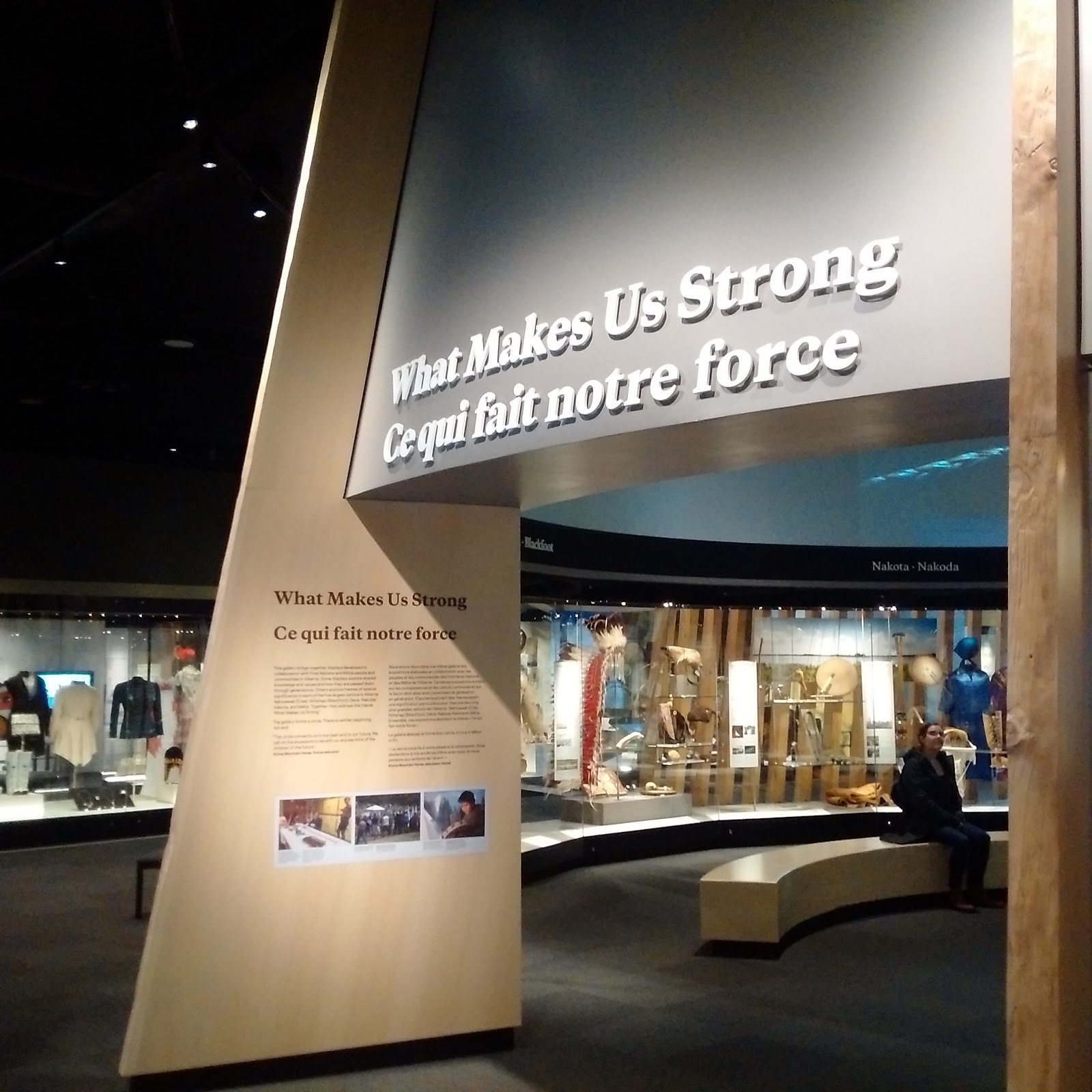
Which brings me to the publicly-funded Royal Alberta Museum (RAM) which re-opened last year in a new building in downtown Edmonton. In this time of reconciliation, I had hopes that the RAM would use it’s new facility to create exhibits that approached the story of Alberta in a more balanced way. I hoped the museum would acknowledge its own founding story based on stolen artifacts and pioneering settlement. Ultimately, I hoped that Indigenous stories of this place would inform the story we tell about who we are as people who make our homes here now. My hopes were all but shattered on my first visit to the RAM last fall shortly after it opened.

It took me a while to process how much the RAM had truly missed the mark. It started with a feeling in my gut of disgust and anger that I couldn’t verbalized at the time. As I walked through the galleries, I was overwhelmed with how much everything was the same as before, perhaps a bit shinier, but the same. Yes, there were some noticeable differences – the presentation of the manitou asiniy, the smattering of Indigenous displays throughout the museum instead of clumping everything together, and the presence of Indigenous languages. That visit left me wondering why they chose to take only a few small steps down this path of truth rather than make leaps and bounds. Why didn’t they do better? Was it because of resources? Time? Willingness? Or all of the above?

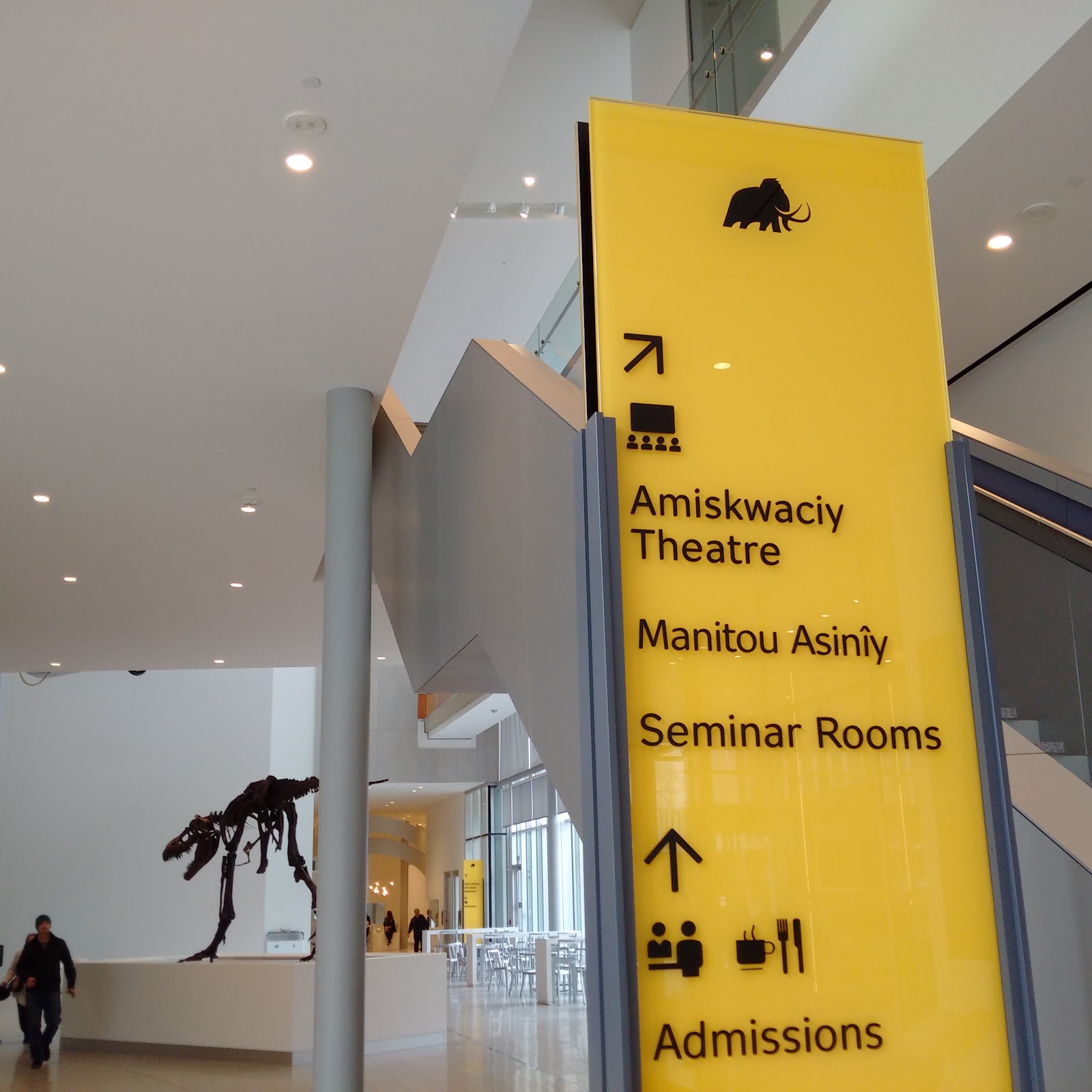
As you walk into the new Royal Alberta Museum, you will see the nehiyaw language used – with capitalization like the English language, perhaps to make it more palatable. (Miranda Jimmy, 2019)

That night I remember running into a few people I knew at the RAM who had also been invited for this private, invitation only event. The settler acquaintances were overwhelmingly in awe of the spectacle that was the new museum. The Indigenous friends were politely pensive. As the weeks and months rolled on and more people had a chance to see the museum, I had the opportunity to talk with others about their impressions of the new RAM. Through these conversations, I was able to focus my own thoughts and reactions to what I had experienced.

A while back, I was invited as a guest to the Canadian Art Gallery Educators symposium held in Edmonton over three days in May. On the final day of the gathering for gallery educators from across Canada, I was on a panel of Indigenous people sharing personal insights. As their guest, I was also able to join in on the other days for tours, workshops, presentations, and networking. When I reviewed the schedule and saw the guided tour of the new RAM, I decided it was time to go back and check in on the feelings I had from my first visit more than six months before. This visit would also allow me to snap a few photos for this blog post that had been festering inside for months.

So what exactly ticks me off about the RAM? I can summarize my feelings in these few points:

1 – Indigenous Peoples had no influential voice in the museum’s creation or renewal.

In Fall 2017, about a year before the new museum opened to the public, I was approached to participate in the Indigenous Advisory Panel. With this panel being formed so close to public opening, it was evident that they were not actually looking for advice that could be implemented but rather, approval of the decisions already made. At this point, the content and design for the main galleries had already been decided, the text panels were written and final construction was nearing completion. In actuality, the RAM wanted rubber-stamping Indigenous People to be champions for them to parade around and say “look at everyone who helped us” providing validity to their colonial practices. No thanks. Like the very premise of settler colonialism, museums are based on the idea of a self-appointed superior culture (ie. the colonizer) deciding they know best and making decisions without including those who are impacted the most. The dominant culture is continuing to steer the narrative and decide how the story of our past and present is told.

Entrance to the Indigenous-focused display in the Human History Hall, which includes personal artifacts from several First Nations and Métis Peoples from Alberta. Not clear if the items were given, loaned, or purchased. (Miranda Jimmy, 2019)

2 – The truth about how artifacts in the collection were acquired is going untold.

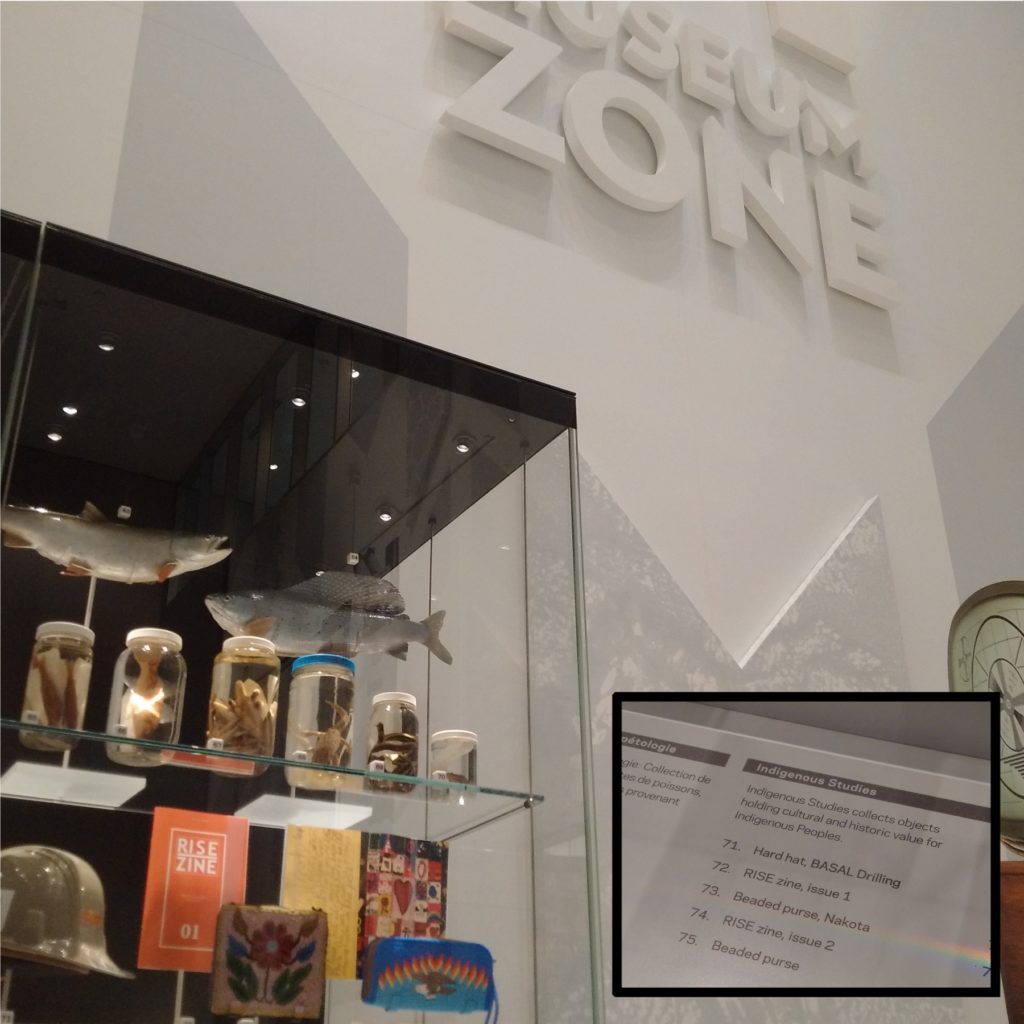
When the first provincial museum opened in 1967 as a centennial project, museology was in it’s pillaging prime. Their goal was to ‘acquire’ items for their collection, perhaps by any means necessary to meet the deadline of opening day. This included using public funds to buy stolen cultural artifacts via pricey auction houses and sending out contracted staff paid with finder’s fees. Both practices removed the museum and the provincial government from directly getting their hands dirty but doesn’t change the story of how these items came to be in the RAM’s possession. For the Indigenous items in their collection, these range from tools from archaeological sites and centuries old beadwork to sacred bundles and items of cultural use taken when ceremonies were outlawed. In order for reconciliation with Indigenous Peoples to be seen as plausible, it must be grounded in truth. The museum needs to tell the truth about who they are and how they came to be in order to have credibility with me and with others. When they are willing to tell the truth about their collection, the next step must be repatriation and redress for the loss. PS: don’t let their mention of this on their website fool you. Their definition of repatriation is like long term loan and covers only Blackfoot items at the moment.

Display in the Museum Zone describing the different museum collections. (Inset) The Indigenous Studies collection is represented by five objects “holding cultural and historic value for Indigenous Peoples” – a hard hat, two beaded purses, and two reconciliation-themed free publications. (Miranda Jimmy, 2019)

3 – Indigenous content is presented through a lens of white fragility.

For me, this is the worst part. It’s like the museum made a decision to incorporate Indigenous content throughout the museum, rather than repeating the old Syncrude Hall of Aboriginal Culture, but wanted to make sure it wasn’t upsetting in any way to the their paying settler customers. There are some specific examples of this in the Human History Hall that caused the most visceral reactions from me. 

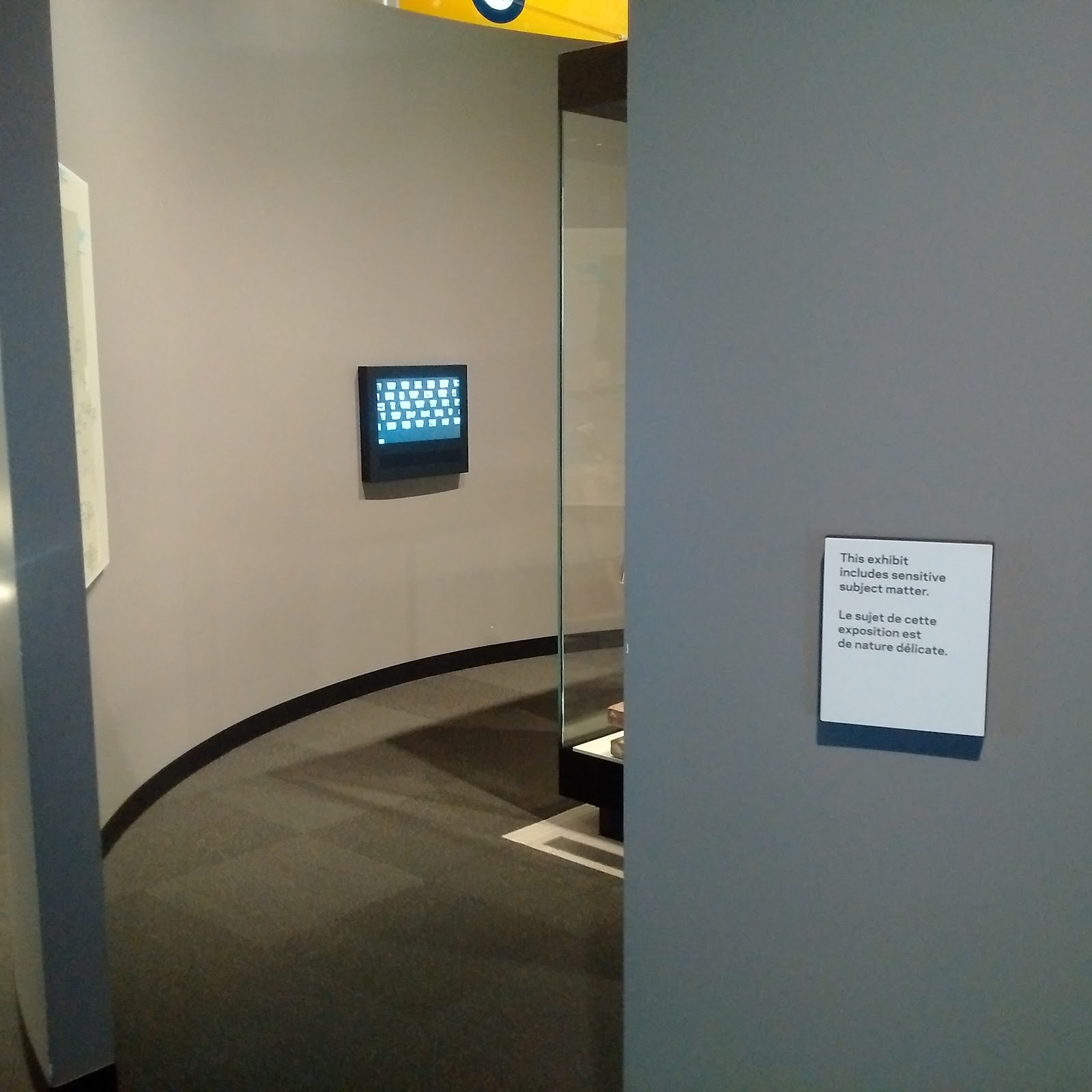
The ‘hidden’ residential schools exhibit in the Human History Hall, which only contains a trigger warning in English and French. What about Indigenous survivors/language speakers who may also be triggered? (Miranda Jimmy, 2019)

The first is the placement and language of the residential schools story. The display sits in a closed off, circular space in the middle of the floor of the gallery, surrounded by unrelated content. I have spoken with so many people who visited the museum and didn’t even know there was a residential school exhibit or they had seen that particular display but didn’t know it was telling the story of residential schools. Unless you are looking for it specifically or are connected to the story in some way, it’s easy to miss it all together. Through the work of the Truth and Reconciliation Commission of Canada, this truth is now available to Canadians. To honour the courage of survivors, we need to tell it in an honest, heart wrenching way.

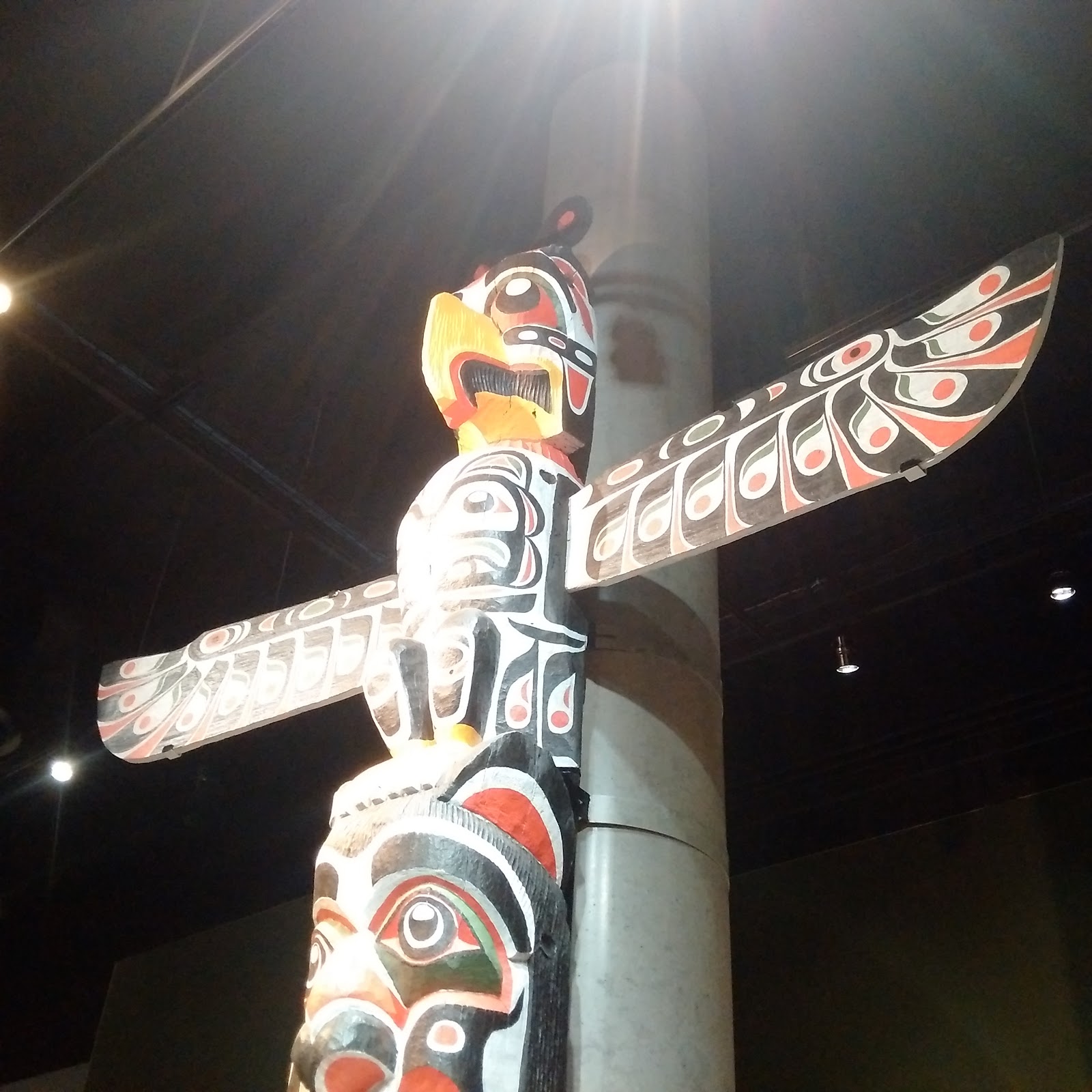
The second example is actually not Indigenous content at all, it’s the presence of the Sunwapta Broadcasting totem pole. Yes, this is a part of Alberta’s past and for some brings back fond memories of yesteryear, especially for settlers who grew up in Edmonton and Northern Alberta. But the act of reconciliation lies in the way we tell this story. The name of this private media company and it’s choice to be branded with totem poles is First Nations cultural appropriation. Sunwapta is from a Stoney Nakoda word and totem poles are cultural practices of many Pacific Northwest First Nations, neither of which are from the traditional territory on which Edmonton was founded. I think that sharing these few sentences with museum visitors would make them feel uncomfortable and put a negative slant on the way they remember the past. This discomfort would not likely to create a repeat visit, and may be a reason why the RAM has shied away from truthtelling.

The Sunwapta Broadcasting Totem Pole, standing outside the Indigenous-focused “What Makes Us Strong” exhibit in the Human History Hall. (Miranda Jimmy, 2019)

4 – Indigenous Peoples are still othered and not presented as foundational.

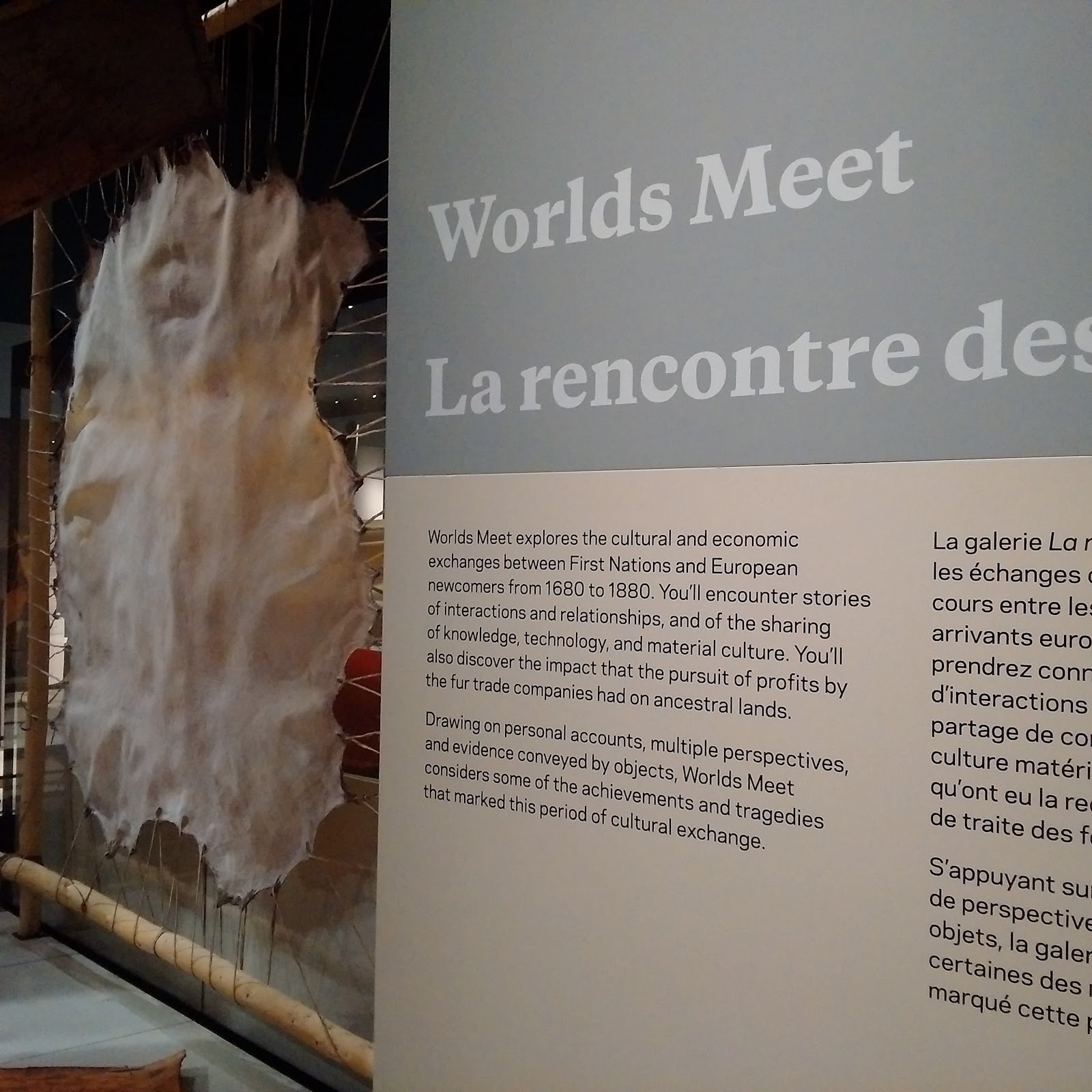
At the root of all of it, this is the problem. The RAM and us as Canadian citizens don’t recognize that the reason we are here in Treaty Six territory is because of Indigenous Peoples. The way in which information about Alberta is presented at the RAM does not consider this fact and puts the focus on the human inhabitants of the last 200 years, rather than the first 20,000+ years. The relative focus of each era implicitly tells visitors what is important. Indigenous voices, perspectives, and opinions have been purposefully excluded at the expense of telling more settler stories, the feel-good memories that perpetuate the pioneering narrative of taming the wild west. Museums like the RAM hold positions of power in the telling of these stories and underlining what is important for each of us to learn about. If these decisions continue to be made by white scholars who have a vested interest in maintaining power, how can we ever know the full truth? When will people from the cultures represented in the museum’s collection be put in charge of how their items are displayed or allowed to decide if that should even happen at all?

In the Human History Hall, the “World Meet” exhibit describes contact between Europeans and First Nations in Alberta. (Miranda Jimmy, 2019)

One act of reconciliation the RAM announced early on was free admission to the museum for Indigenous Peoples. Not charging me admission to see the items you stole from my ancestors is the VERY LEAST thing you could do. The First Peoples of this place were robbed of culture, language, traditions, and life because of colonization and the settlers who have come since have benefited from that loss tremendously. And through this loss, settlers have also missed out on learning from this traditional knowledge and applying it to our relationships with the land and with each other. Remember, Indigenous Peoples are still here and not all opportunities to learn from these teachings has been lost as long as settler society is willing to listen and adapt.

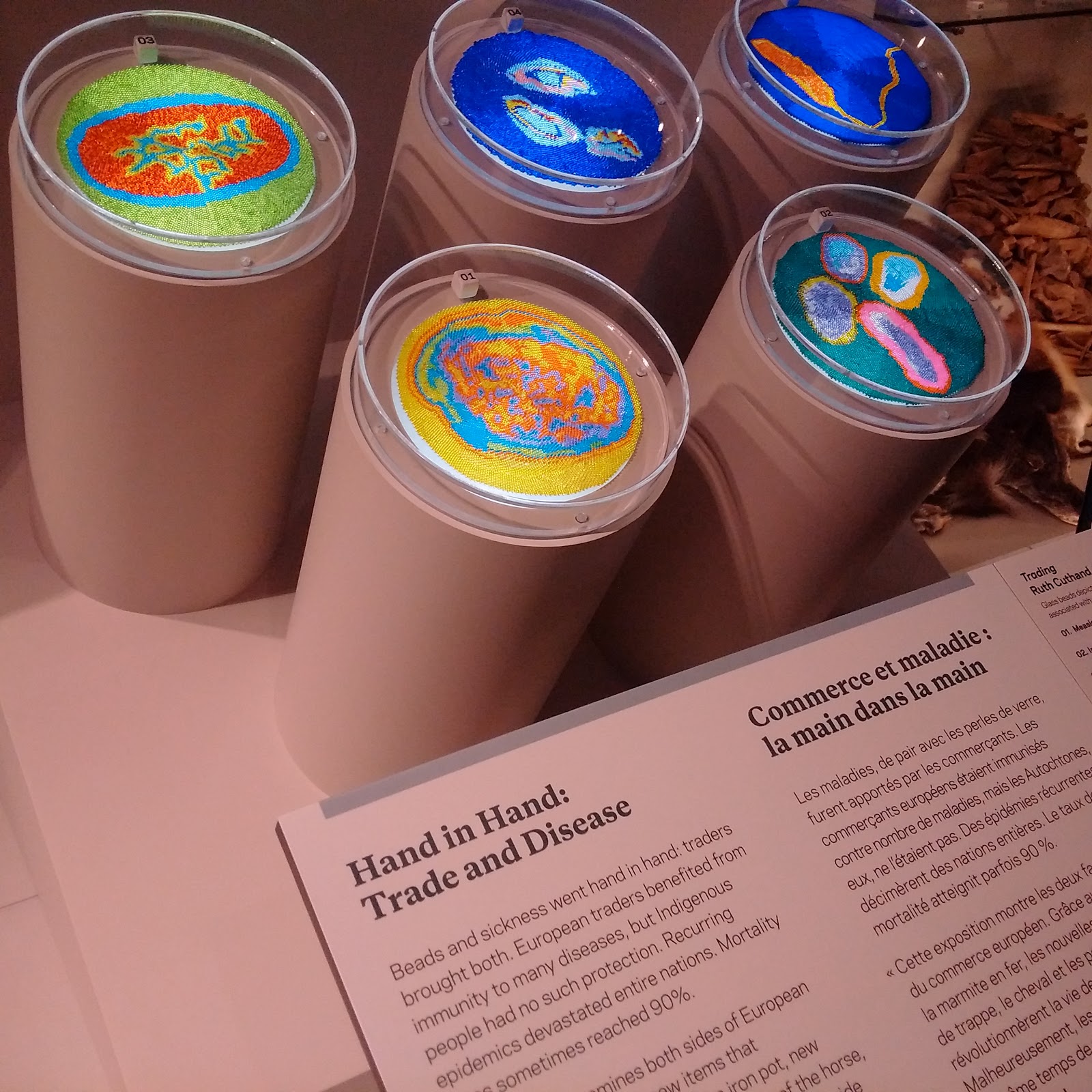
“Trading” (Ruth Cuthand, 2018), one interpretation of the European decimation of First Nations by Europeans after contact. (Miranda Jimmy, 2019)

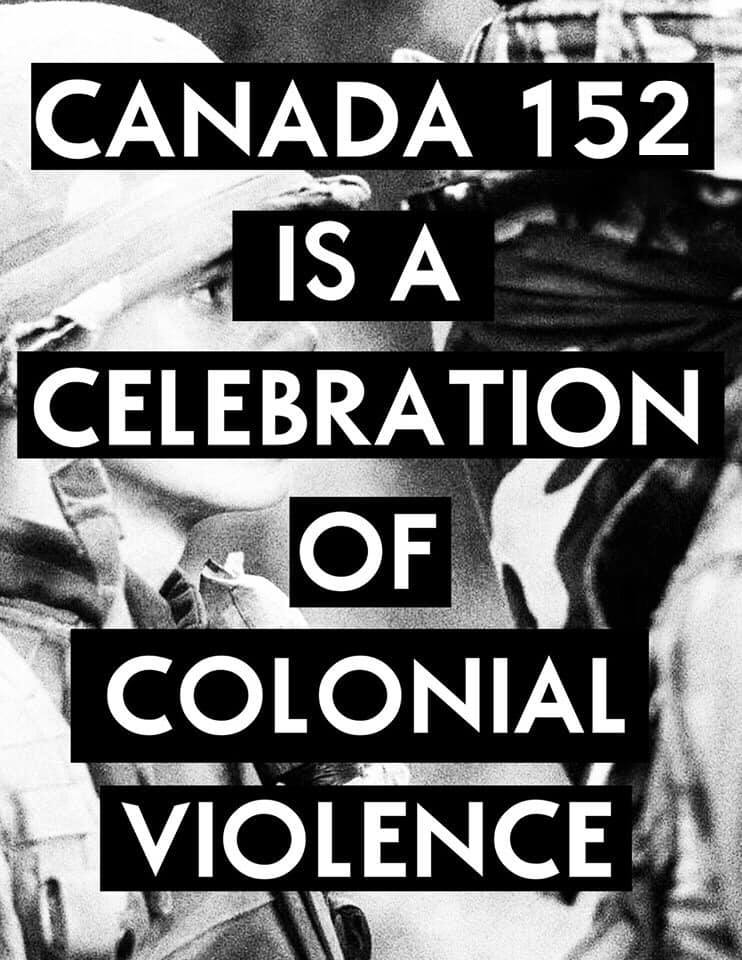
On this 152nd anniversary of the Constitution Act, I will be taking time to reflect on what legislation has led us to today and what acts of defiance will help us heal from it. The story we tell ourselves about who we are as Canadians is based in this idea of a cultural mosaic – a place where you can come to practice your culture, speak your language, and teach your traditions to your children. But it is those very things that were taken away from the Indigenous People who were here first. Let’s start telling the truth and reconciling its impact, in our publicly funded institutions and in ourselves.

Happy Decolonization Day, everyone!

(Nanook Gordon Fareal, 2019)

Reminder: There’s work to do

Mayor and members of Edmonton City Council:

On the four year anniversary of the TRC’s release of the executive summary of their final report and the 94 Calls to Action, I am writing to remind you of your past, present, and future commitments to truth and reconciliation in our city. I am also writing to acknowledge that some of this work sits on the shoulders of the agencies, boards, and commissions that you provide funding to.

Earlier this year, I received a small travel grant from the Edmonton Heritage Council to attend and present at a symposium in Winnipeg hosted by the Indigenous Heritage Circle, a national organization I have been connected with for several years now. My presence at the two-day gathering allowed me to not only share Edmonton-based work I completed in conjunction with local archives but also act as the only representative from our province at the event. While I am grateful for this support, a few hundred dollars does not scratch the surface of changing how Indigenous Peoples are represented in our memory institutions or our current civic fabric. Over the past four years, I have yet to see the tangible impact of the TRC in transforming the way that EHC or the City of Edmonton supports, collaborates with, and listens to the Indigenous Peoples of our city.

The TRC’s Calls to Action created a framework for Canadians to begin the work of reconciliation. On anniversaries like this, I take the time to reflect back and consider the progress that has been made as well as the missed opportunities for improvement. Today, I ask you to do the same. Perhaps, this is a good time to revisit and re-read the Calls to Action for yourself and consider their practical application in your daily work.

  • Are you considering the impact of your decisions on the Indigenous Peoples of our city with each vote in Council Chambers?
  • Are you reaching out to your Indigenous constituents and neighbours to encourage their involvement in civic life?
  • Are you continuing to educate yourself on the impacts of historical trauma, colonization, and your obligations in the treaty relationship?

As elected officials in our city, you can set an example for other community leaders to follow. Your daily, proactive commitments to reconciliation show others that this work is an ongoing process and can create change if we all step up to the challenge. There is a community of survivors in our city and across the region that are also watching and listening, expecting you to approach your work differently because of the TRC. The sacred fire that burned four years ago on the steps of City Hall collected the tissues and tears of centuries of loss as well as hope for healing. I hope that your commitments to better relations with Indigenous Peoples is seen more often and that you expect the same from those that you provide public funding to.

In solidarity,
Miranda Jimmy


The preceding letter was sent to all members of Edmonton City Council, along with the Edmonton Heritage Council Executive Director and grants staff on June 2, 2019 to meet the final reporting requirements of a grant. 

Put Your Money Where Your Mouth Is

Good afternoon “Day Star” and other members of Edmonton City Council. My name is Miranda Jimmy and I am a proud member of Thunderchild First Nation who has made my home in Edmonton for nearly 20 years. I sit before you has a partner, committed to fulfilling the Treaty Six relationship.  I also want to acknowledge Heather Shillinglaw, a local Métis visual artist and arts educator, who has joined me here today.

On August 9th – the United Nations International Day of the World’s Indigenous Peoples, I sent a letter to each of you expressing my concerns over the lack of commitment from both the City of Edmonton and it’s agencies and boards to the needs of Indigenous Peoples and the cause of reconciliation in our city.

Last month, despite concerns raised by myself and other leaders in the Indigenous community, you chose to approve, by consensus, the new 10-year Arts and Heritage Plan for the city that lacked meaningful Indigenous involvement in it’s creation – not even including the Edmonton Arts Council’s own Indigenous Advisory Committee which I was a member of. The plan contains no actionable commitments to serve Edmonton’s Indigenous peoples or organizations for the next ten years. In approving the plan without debate, you have set a precedent of lip service leadership for others in our city to follow in serving the Indigenous community. I have shared with you a letter this afternoon from Marilyn Dumont, renowned Métis poet, who was unable to be here this afternoon but also wanted to share her concerns.

Earlier this month, many of you joined members of the Métis community right behind you in the City Room to declare it Métis Week in the city of Edmonton. You spoke about the importance of this relationship in both Edmonton’s past and future. But words have to be backed up by action and resources to support that action.

2019 will mark five years since the Truth and Reconciliation Commission of Canada held its final national event down the street at the Shaw Conference Centre. Mayor Iveson – you were an honorary witness to the testimony of hundreds of survivors of the Indian Residential Schools system. You heard how that experience, along with the other colonial systems and systemic racism, has impacted the rest of their lives. A year later, here in Council Chambers, we streamed the TRC closing events from Ottawa and gathered by the sacred fire outside City Hall to reflect on the impact this testimony would have on us as a city and a nation.

Since then, eagle feathers have been given and gifts exchanged. You have all had the opportunity to attend sweat ceremonies and pipe ceremonies with the Elders of Treaty Six. You have committed to that Treaty relationship both in your words and with your spirit. But reconciliation is not measured by the words that were said and the commitments that were made but on your ability to deliver on them.

In the coming weeks, you will be making funding decisions on behalf of the citizens of our city for the next four years. You will also be providing funding to agencies that will provide services to the people of Edmonton. You hold a lot of power in improving the lives of the most marginalized in our city without ever hearing from them directly in Council Chambers. I am hear to provide you with wake up call.

As a city administration and as a Council, you continually speak about reconciliation. In order for Indigenous people like me to believe your words, you must start to prove it through the funding allocations you approve. There has to be accountability and long term change for Indigenous peoples to begin to take you at your word.

I want to see direct investments in the lives of Indigenous peoples in our city. I want to see changes to the systems that were created to keep Indigenous peoples excluded and on the margins of society. I want to see how the training you are implementing for city employees is changing the way you meet the needs of Indigenous peoples. And most of all, I want more ways for Indigenous peoples to be involved with and leading these conversations.

Three years ago at budget time, fellow members of my organization RISE – Reconciliation in Solidarity Edmonton made this same request to the then City Council. Since then, there has been ample opportunity for you to show your commitment through multi-year funding. There has also been an opportunity for you to expect demonstrated commitments from your agencies and boards to put in place plans to include Indigenous perspectives at every level of their organization and find tangible ways to support reconciliation.

Stop throwing around buzzwords like inclusion and reconciliation and treaty if you are not willing to make every decision through these lenses. Indigenous people need allies in leadership who are willing to stand up for their needs and make decisions for us, with us. I know this is a tough budget cycle and you will be forced to make some hard decisions. My only request is that you start putting your money where your mouth is when it comes to Indigenous peoples.

This conversation is not going away. Until you begin to show accountability to the Indigenous community, I will continue to speak up. As always, I am happy to provide you with tangible examples on how you can do this and who can help make this happen. I look forward to answering your questions today and am also willing to speak one-on-one as well.


The preceding  speech was shared at Edmonton’s City Council 2019-2022 Budget Public Hearing on November 28, 2018. A video recording of the proceedings can be found online here.